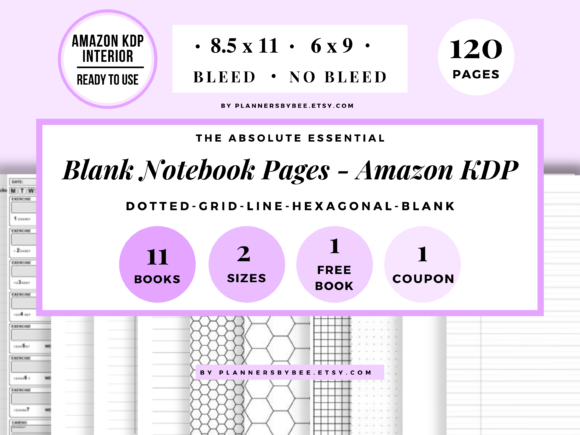
KDP Interior Templates 12 Books 120 Page: Your Publishing Launchpad
Let's be honest. The hardest part of publishing a low-content book on Amazon KDP isn't always the cover design or the marketing plan. It's often the interior. Staring at a blank document, trying to figure out margins, bleed areas, and consistent page layouts for a 120-page notebook or journal can stall a project for weeks. This is where a practical solution like the KDP Interior Templates 12 Books 120 Page collection becomes less of a product and more of a project partner. It's a set of 12 complete, ready-to-use interior files designed to eliminate that initial friction and get you straight to publishing.
What Exactly Are These KDP Interior Templates?
At its core, this is a bundle of 12 PDF files. Each file is a complete, 120-page interior for a low-content book. Think of them as the foundational "typeface" for your book's interior design—just as a premium font provides the character for text, these templates provide the essential structure. They aren't flashy; their personality is one of clean functionality and professional neutrality. The visual style is intentionally minimal, typically featuring simple ruled lines, dotted grids, or completely blank pages. This minimalism is their greatest strength, offering a versatile canvas for a huge range of projects.
The templates come in two critical industry-standard sizes: 6" x 9" and 8.5" x 11". This covers the most popular dimensions for journals, planners, and notebooks on Amazon. More importantly, they are provided with both with bleed and no bleed versions. Understanding this is key for any publisher. "Bleed" refers to the area where your design extends to the very edge of the page. For a book with a printed background color or image that goes to the edge, you need the bleed version. For a simple black-and-white text interior on white paper, the no-bleed version is correct. Having both options included prevents a common and frustrating rejection from the KDP review process.
Where Do These Templates Deliver Real Value?
The applications are broad, but they all center on publishing and personal or commercial creation. For the entrepreneur or small business owner, these templates are a direct path to creating branded notebooks, client planners, or workshop workbooks. Imagine a real estate agent creating a "Home Buyer's Journal" for clients, or a fitness coach bundling a gym fitness log with their training program. The template provides the professional interior; you add your cover and branding.
For designers and content creators, this collection is a toolkit for rapid prototyping. Instead of building layouts from scratch, you can use a lined journal paper template to mock up a cookbook layout, testing how recipe text and images would flow on the page. A planner template can be used to design a digital or print product for sale on Etsy or your own site. The blog or marketer can create lead magnets—downloadable PDF workbooks or challenge journals—that feel substantial and well-crafted, enhancing perceived value.
Practical Guidance for Using the KDP Interior Templates
Treat these templates as a starting point, not an end product. Your brand identity comes through in the customization. Here’s how to approach them effectively:
- Evaluate Project Fit: Choose the template that matches your book's purpose. A graph paper interior is perfect for bullet journals, design sketches, or data tracking. A diary style with dated lines suits a traditional journal. The blank pages offer maximum flexibility for scrapbooks, sketchbooks, or photo albums.
- Customize with Purpose: Use a tool like Adobe Acrobat, Canva, or even PowerPoint to add your elements. This is where you can introduce a creative font for chapter titles or section headers. Add a subtle header with your brand name or a footer with page numbers. The goal is to enhance, not clutter. The template's neutrality means it will work with a serif font for a classic feel or a sans serif font for a modern look.
- Focus on Readability: Even in a blank journal, consider the user experience. If adding text, ensure the font pairing is harmonious—a simple script font for a title might pair well with a clean sans serif for body instructions. Test printed samples to check line spacing and ink density.
- Leverage the Sizes: The 8.5" x 11" size is excellent for workbooks, planners, and editorial design projects where you need more writing space. The 6" x 9" is the classic, portable journal size, perfect for personal use books that readers carry with them.
Remember, the commercial licensing for these templates typically allows you to sell the final PDF or printed book you create with them. You are not reselling the blank template itself. This makes them a legitimate design asset for building a publishing business or a product line.
The Professional Edge: Consistency and Perception
Using a well-structured template directly influences how your book is perceived. A consistent interior layout across all pages signals professionalism. It shows attention to detail, which builds trust with your audience. For a series of books—say, a line of planners for different goals—using the same base template ensures brand consistency. A customer who buys your "Budget Planner" will recognize the quality and structure in your "Fitness Planner."
This consistency aids in visual hierarchy. Even with lined pages, the uniformity of the margins, line weight, and spacing guides the user's eye and makes the book intuitive to use. It reduces cognitive load, allowing the user to focus on their thoughts, plans, or sketches rather than on navigating a poorly designed page.
Ultimately, the KDP Interior Templates 12 Books 120 Page collection is about removing barriers. It handles the technical, time-consuming aspects of interior design so you can focus on your idea, your content, and your audience. Whether you're a first-time publisher testing the waters of Amazon KDP or an established creator looking to streamline production, having a set of reliable, correctly formatted interiors is a practical advantage that translates directly into published books and tangible products.