Mastering Medical Concepts: The Pharmacist's Toolkit
In the fast-paced world of healthcare education and professional practice, information overload is a genuine risk. Whether you are a nursing student grappling with complex drug interactions or a seasoned practitioner looking for a quick refresher, the tools you use to organize that data matter just as much as the data itself. This is where the concept of Pharmacology Templates transcends simple note-taking and enters the realm of strategic knowledge management. It is not merely about having a place to write; it is about creating a visual ecosystem that supports memory retention, clarity, and professional accuracy.
Visual Clarity and the "Pharma Template" Aesthetic
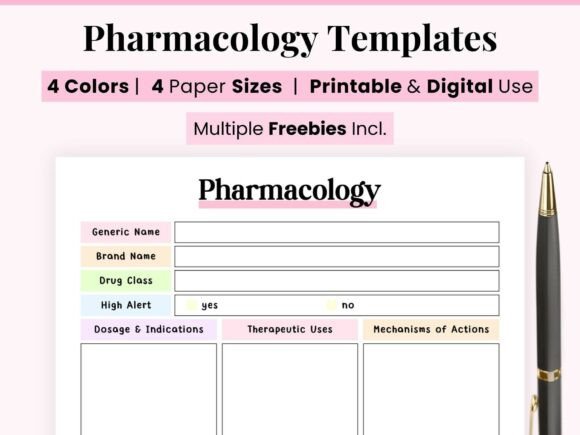
When we talk about the Pharma Template design philosophy, we are discussing a specific approach to information architecture. Visually, these templates often reject the clutter of traditional medical textbooks. Instead, they embrace a "clean clinical" aesthetic—think structured grids, ample white space, and a deliberate use of typography to separate headers from content. The personality of a well-designed Pharma Template is authoritative yet accessible. It doesn't intimidate the user with walls of text; rather, it invites them in with logical flow.
The visual characteristics rely heavily on hierarchy. In a high-stakes environment, you cannot afford to hunt for the "Adverse Effects" section. A superior Pharmacology Template uses bold headings, perhaps color-coded tabs, and consistent iconography to guide the eye. This is where the principles of modern typography come into play. The choice of font isn't just decorative; it is functional. A clean sans serif font is often preferred for body text to ensure legibility at small sizes, while a distinct header font establishes the hierarchy. This blend of utility and aesthetics ensures that the learning process feels less like a chore and more like a curated experience.
Strategic Applications: From Study Sessions to Clinical Practice
The utility of these design assets extends far beyond the classroom. For the aspiring healthcare professional, tools like the Pharma Template Chart and Note Sheets for Nurses serve as the bridge between theoretical knowledge and practical application. Consider the Classification Study Guide. In a clinical setting, rapid identification of drug classes is vital. A well-designed guide uses visual cues to group medications, leveraging the brain's ability to process patterns. This is graphic design applied to survival.
For the entrepreneurial nurse or medical blogger, these templates offer a foundation for brand identity. If you are creating educational content or selling digital downloads, the consistency of your templates signals professionalism. Using a cohesive set of design assets—from the FNP Exam Nursing Bundle to Med Flash Cards—ensures that your audience associates your content with reliability. It transforms a simple PDF into a premium font and layout experience that feels trustworthy.
Furthermore, the portability of tools like Med Flash Cards cannot be overstated. In the digital age, these assets must translate across mediums. Whether viewed on a tablet during a commute or printed for a study group, the layout must remain intact. This requires a thoughtful approach to web design and print compatibility, ensuring that margins, bleed areas, and font rendering are consistent.
Choosing the Right Tools for Your Medical Brand
Selecting the right Pharmacology Templates is an exercise in strategic decision-making. It is not enough for the design to look good; it must serve the specific needs of the project. When evaluating a Pharma Template, consider the "personality" of the content. Are you dealing with pediatric nursing, which might benefit from a softer, more approachable layout, or pharmacology, which demands a rigid, scientific structure?
Evaluating project fit involves looking at the included styles. Does the bundle offer enough variety? A comprehensive collection should include everything from detailed Pharma Template Charts to quick-reference Note Sheets for Nurses. You need assets that can handle the heavy lifting of a Classification Study Guide as well as the brevity required for social media graphics.
Readability is the non-negotiable standard. In medical contexts, ambiguity is dangerous. When reviewing templates, look for how they handle dense information. Do they use bulleted lists effectively? Is there enough contrast between the background and the text? A good creative font choice should be legible, but the layout structure is what ultimately ensures comprehension. For example, pairing a serif font for section headers with a sans serif font for instructions can create a pleasing visual rhythm that aids in scanning.
Finally, consider the adaptability of these assets for your own brand identity. If you are a content creator or a small business owner in the health space, these templates are not just for personal use; they are part of your visual language. Customizing them to fit your color palette or logo design helps in building recognition. Whether you are using them for packaging design for health supplements or editorial design for a medical newsletter, the underlying structure of a high-quality Pharma Template provides the professional scaffolding you need to build authority and trust in your niche.